Ferrous metals include mild steel, carbon steel, stainless steel, cast iron and wrought iron. These metals are primarily used for their tensile strength and durability, particularly mild steel which helps support the tallest skyscrapers and longest bridges in the world. You can also find iron and its alloys in house construction, industrial containers, large-scale piping, automobiles, railroad tracks, most of the tools and hardware you use around the house and the knives you cook with at home.
Due to the high amounts of carbon used during their creation, most ferrous metals and ferrous alloys are vulnerable to rust when exposed to the elements. While this is not true of wrought iron, which is so pure iron that it resists oxidation,
The terms sandblasting and shot peening in Korea are sometimes used interchangeably but in fact they describe two very distinct procedures for surface treatment and finishing in different industrial fields.
What is sandblasting?
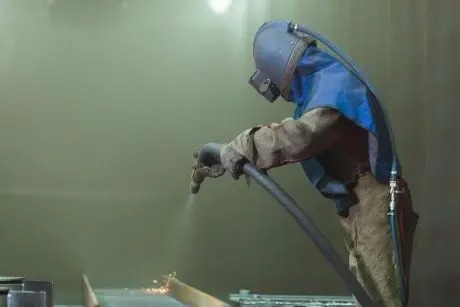
Sandblasting is the procedure that allows you to remove and eliminate, with a stream of abrasive and air launched at high speed and at very high pressure, impurities and corrosive slags: paints, rust, oxides, sand and calamine. In this way the surface can be prepared in order to create the best adhesion between the surface and the coating that will be applied or reapplied on the it.
For the sandblasting process, various types of abrasive material are used depending on the result to be obtained in terms of cleanliness and roughness of the surface. Mineral abrasives such as Garnet, Corundum or glass can be used,
The sandblasting process is a mechanical technique for the controlled cleaning of a surface, usually metallic. It is made by erosion thanks to the abrasion generated by propelling metal shots or grit with compressed air lances.
Another method uses wheel blasting machines. The sandblasting process, in addition to allowing the surface of a metal product to be cleaned from residues and corrosive scales, can also be used to obtain a particular
If you work in the blasting industry, you know that choosing the right material for your abrasive is crucial to achieving the desired result. Two of the most common materials used for making metal shot are steel and cast iron, but people are often unsure of the difference between the two. In this article, we will explore the differences between cast iron and steel and how these affect the choice of the right abrasive for your blasting process.
Cast iron is an iron alloy with a significant amount of carbon, usually between 2.1% and 4.3%: thanks to this feature, cast iron is an extremely hard material, ideal for applications requiring strong abrasion such as blasting cast iron parts, cleaning boiler pipes, removing resistant paint, and much more.